


The Museums, Citizen's Well-(Li)ving Room A project implementing a Museum Social Prescribing system to transform museums into preventive health infrastructures addressing social isolation


- Nationality
- Korea, Republic of
- Group
- Hana Joo
About Project
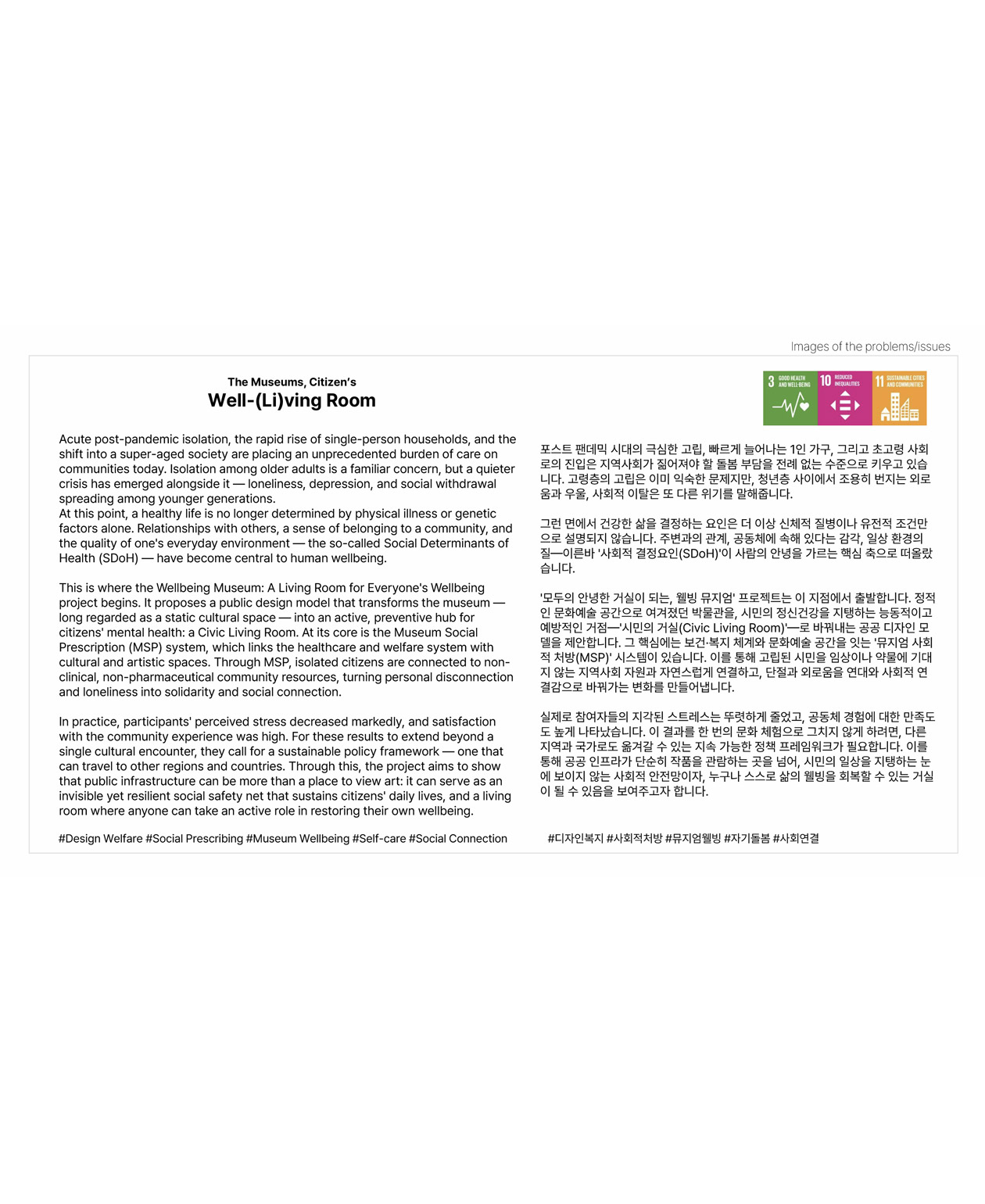
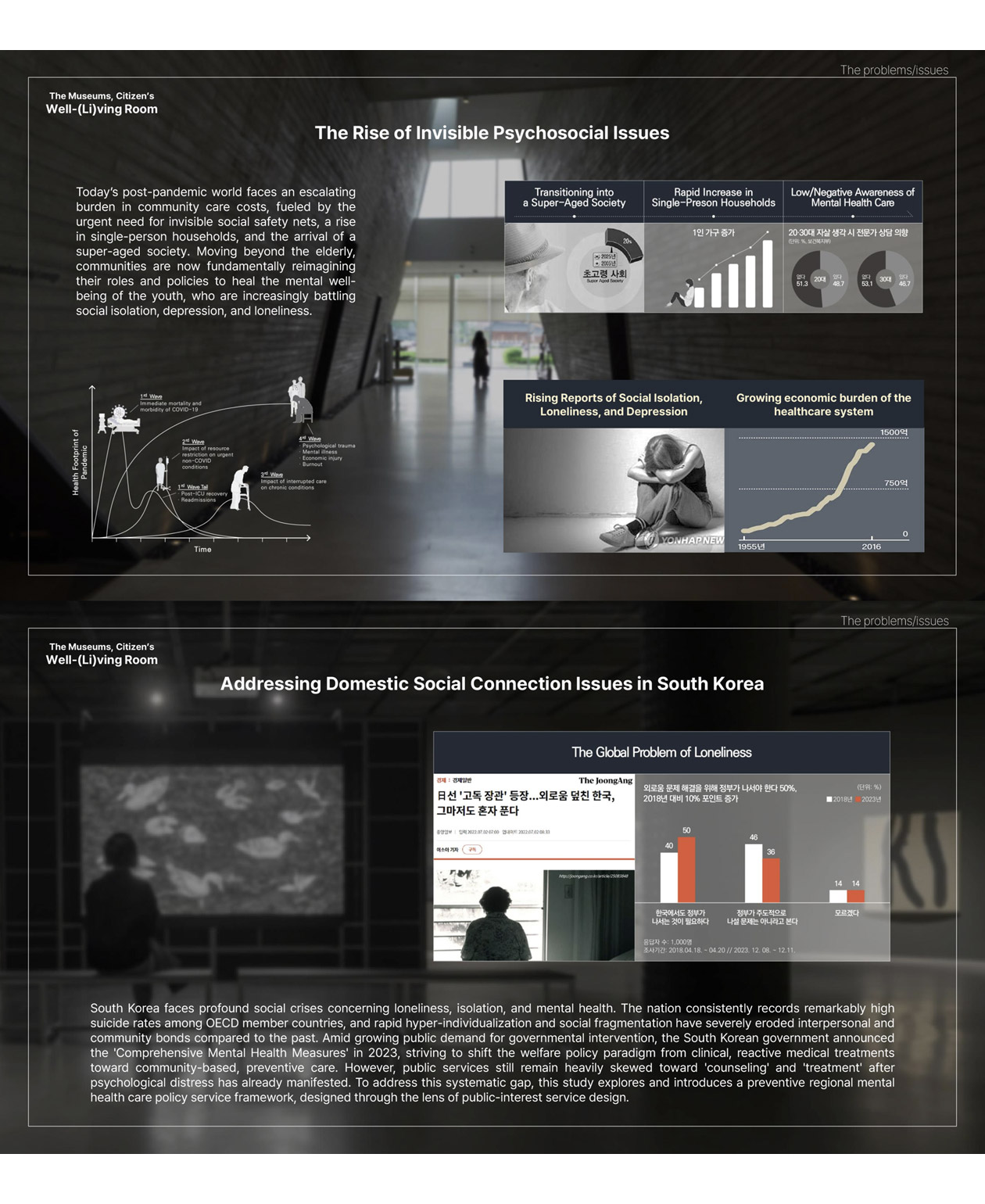
[The Museums, Citizen's Well-(Li)ving Room] is a public service design project that utilizes local art museums as preventive public health infrastructure to respond to modern societal problems such as aging, mental health crises, and social isolation. Instead of building new medical facilities, it provides “Museum-based Social Prescribing (MSP)” services utilizing existing non-clinical cultural spaces and resources rather than hospitals. It connects citizens in need and the general public with art-based healing programs to help individuals recover psychologically and restore relationships and exchanges within the community. It is characterized by expanding the traditional functions of art museums, which were centered around exhibitions and viewing, into everyday public services that support citizens' health and relationship building.
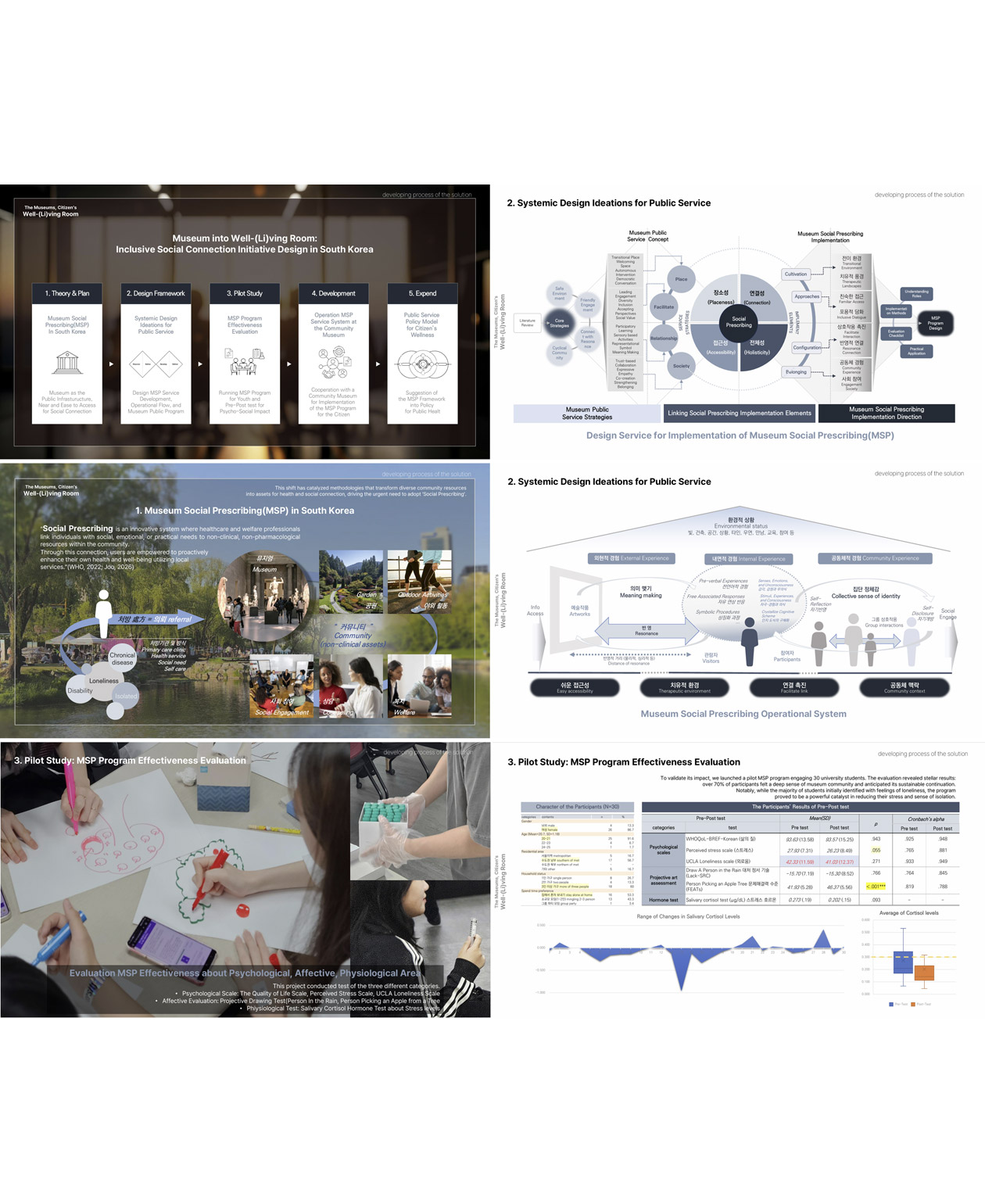
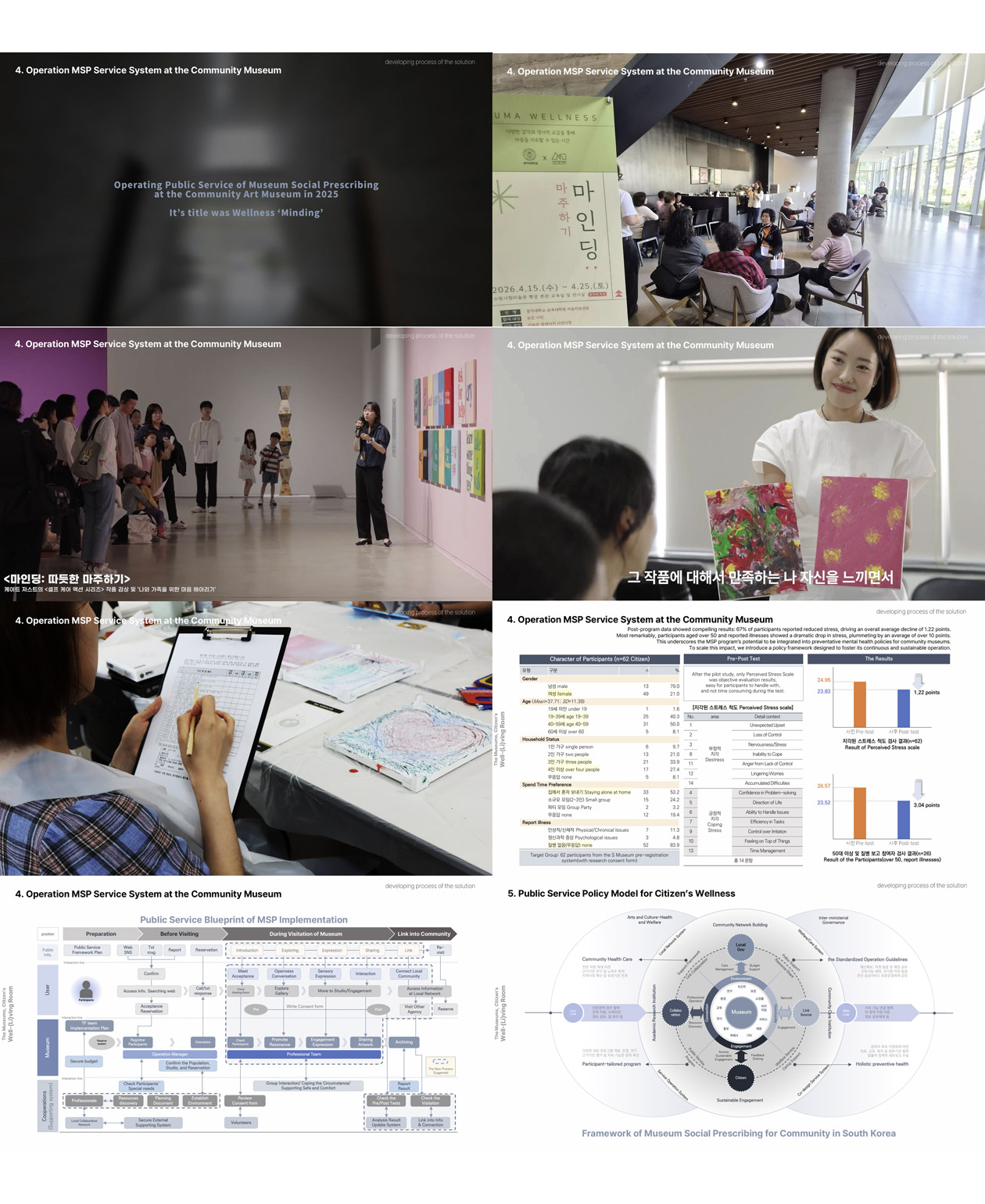
[First, the entire process of MSP services was structured utilizing the Double Diamond framework of service design, and the core principles were visually organized. Second, through a pilot study, psychological, emotional, and physiological changes were measured to empirically confirm stress reduction and changes in social activity. Afterwards, actual programs were operated in local art museums to expand participation, and the possibility of art museums functioning as spaces capable of providing preventive mental health services was verified. Rather than just proposing the concept of the service, the process leading from research, design, demonstration, to field application was constructed step by step.
[Based on these research and operational experiences, a Service Blueprint was developed to continuously operate MSP services in the community. By structuring both the process in which participants experience the service and the museum's operational system supporting it, a foundation was established to repeatedly operate it in actual fields. In addition, considering the different environments of domestic art museums, a Delphi study and Importance-Performance Analysis (IPA) were conducted, and based on this, a comprehensive operational system was prepared and applied to actual fields.
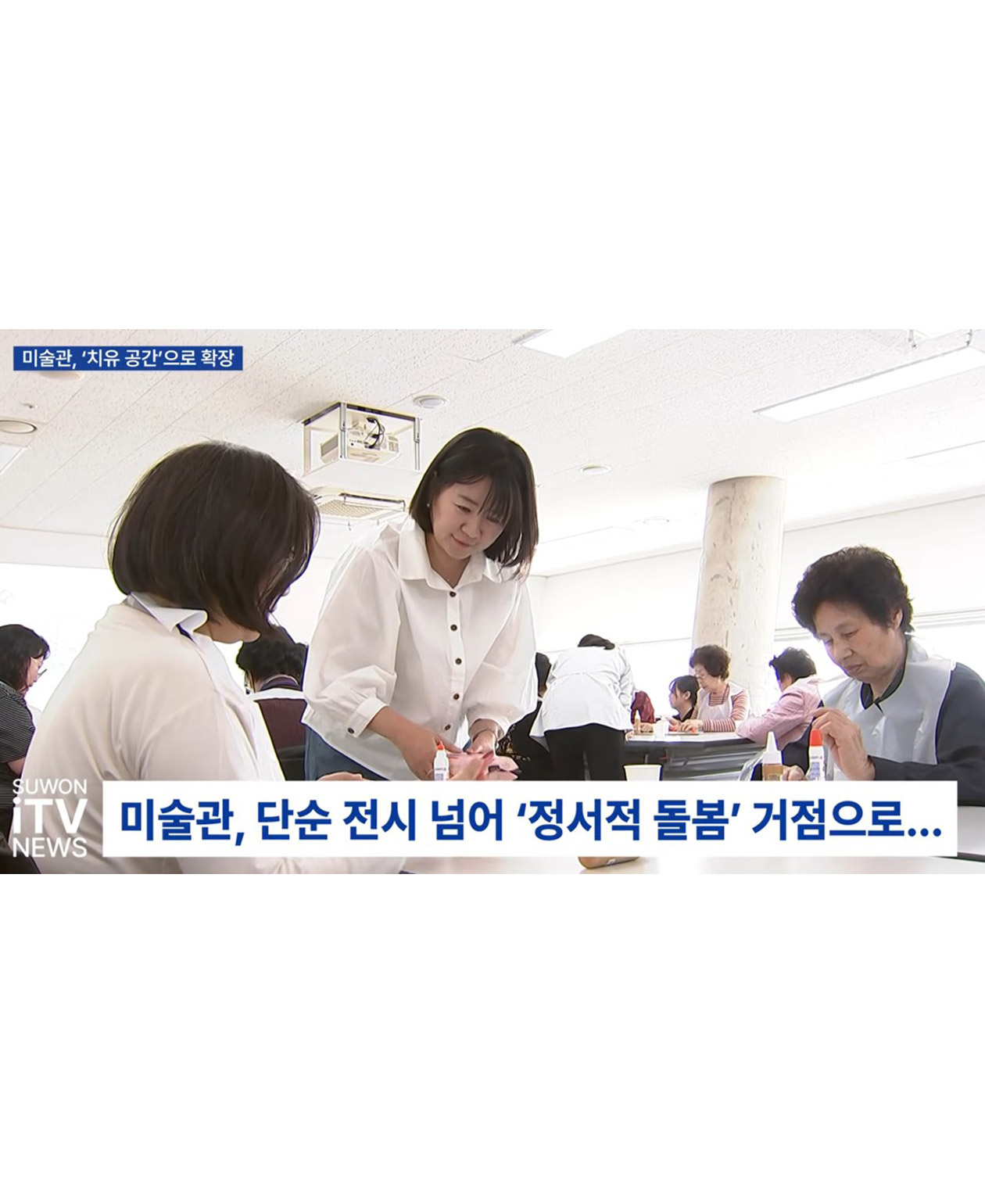
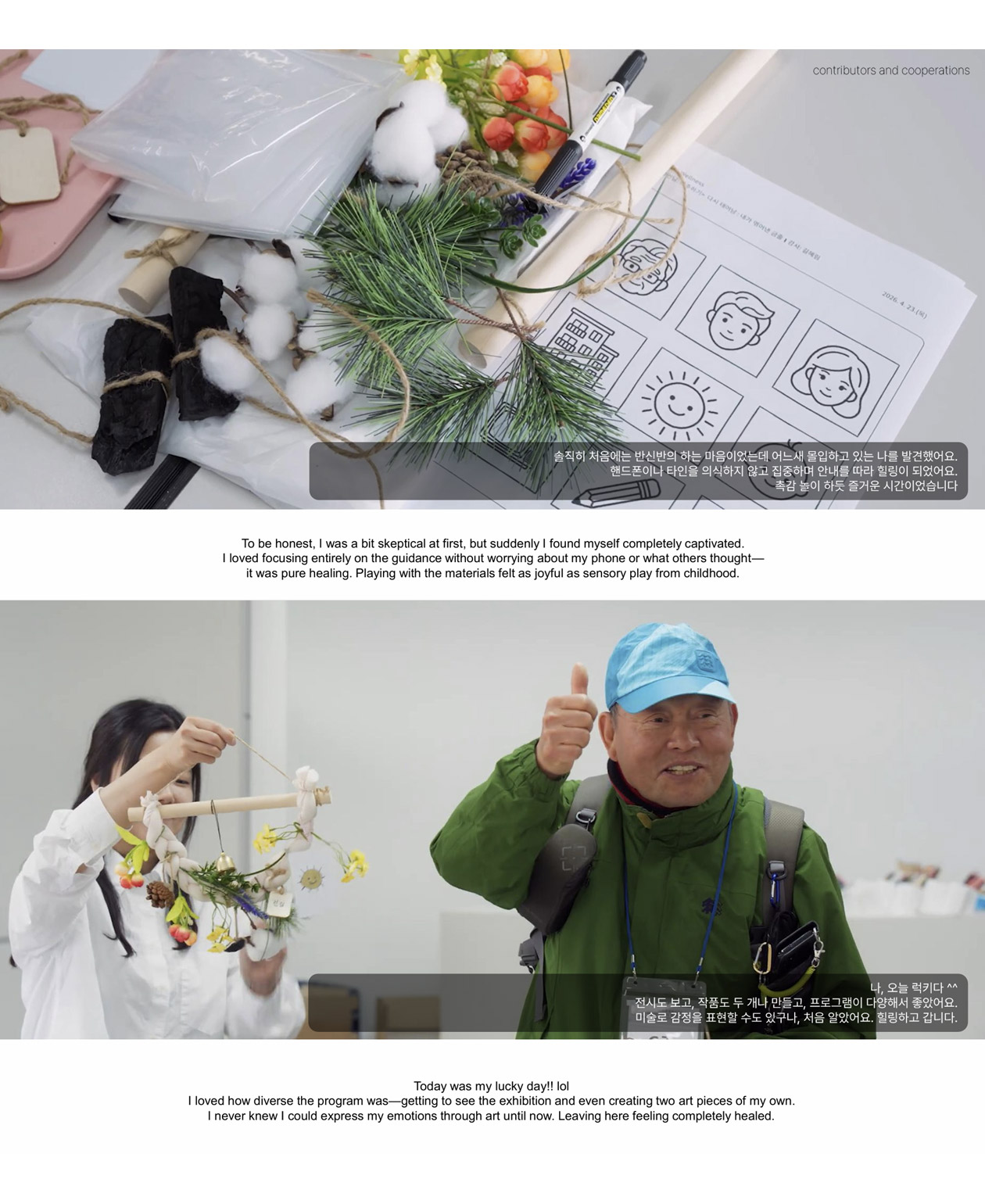
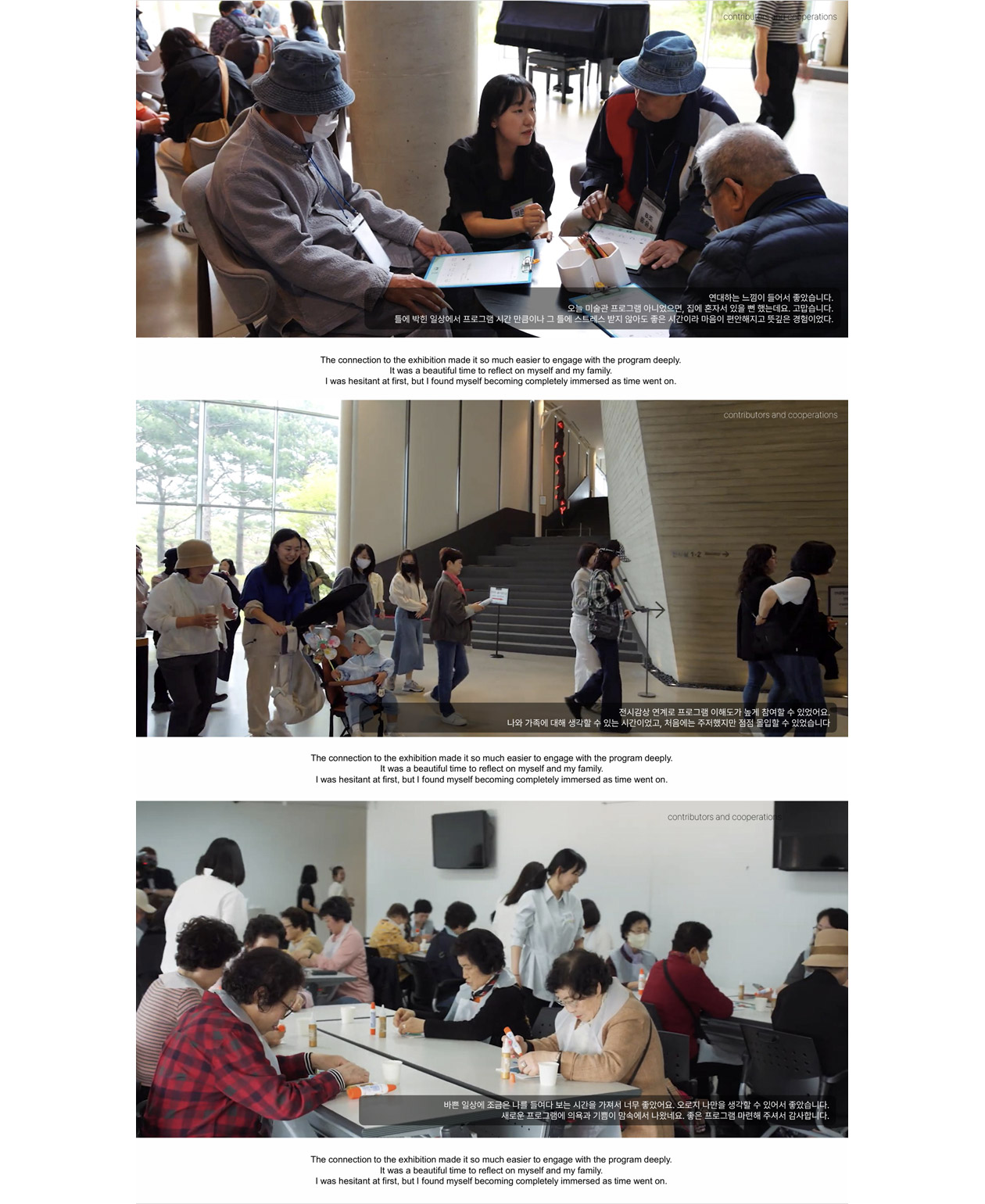
[This project implemented the concepts of the research stage into actual public service by operating multi-session programs for 62 municipal art museum participants. As a result of the analysis, participants' stress decreased statistically significantly, and improvement effects were confirmed in stress-coping abilities and social interaction. Through this, it showed the possibility of preventive care where citizens can manage their own mental health in everyday cultural spaces and form relationships with others. It shows a social design approach that connects cultural spaces, citizens, and art programs into a single service experience so that preventive care can take place in everyday environments.
[Another characteristic is that because existing art museums are utilized, preventive mental health services can be established within the community without having to construct new medical facilities. As cultural spaces take on the role of supporting citizens' psychological health and social relationships beyond the functions of exhibition and viewing, they can also contribute to reducing the burden on the public healthcare system in the long term. Through this, art museums are expanded into everyday cultural spaces of the community and social safety nets supporting preventive care. It suggests the possibility of sustainable public service in that rather than adding new facilities, it reconstructed the roles and usage methods of already existing public resources.
[The operational system was standardized so that it can be applied in other art museums as well. Art museums were categorized into three operational types according to their legal classification and service capacity, allowing each institution to introduce MSP services according to its conditions such as size, budget, and location. Rather than applying a single operational method as is, services can be configured in ways that fit each institution's conditions, enabling expansion into various regions and cultural environments. It was designed to be utilized according to the resources and environment possessed by each art museum by considering both the standardized service system and the flexibility of application by institution.
[These operational systems are also connected to the United Nations Sustainable Development Goals (SDGs) “Goal 3: Good Health and Well-being” and “Goal 11: Sustainable Cities and Communities.” By supporting citizens' mental health and social relationships utilizing existing cultural spaces, it suggests a way for art museums to expand their role as universally accessible preventive healthcare hubs in the community.